
Gaming and Mental Health for Gay and Queer Men
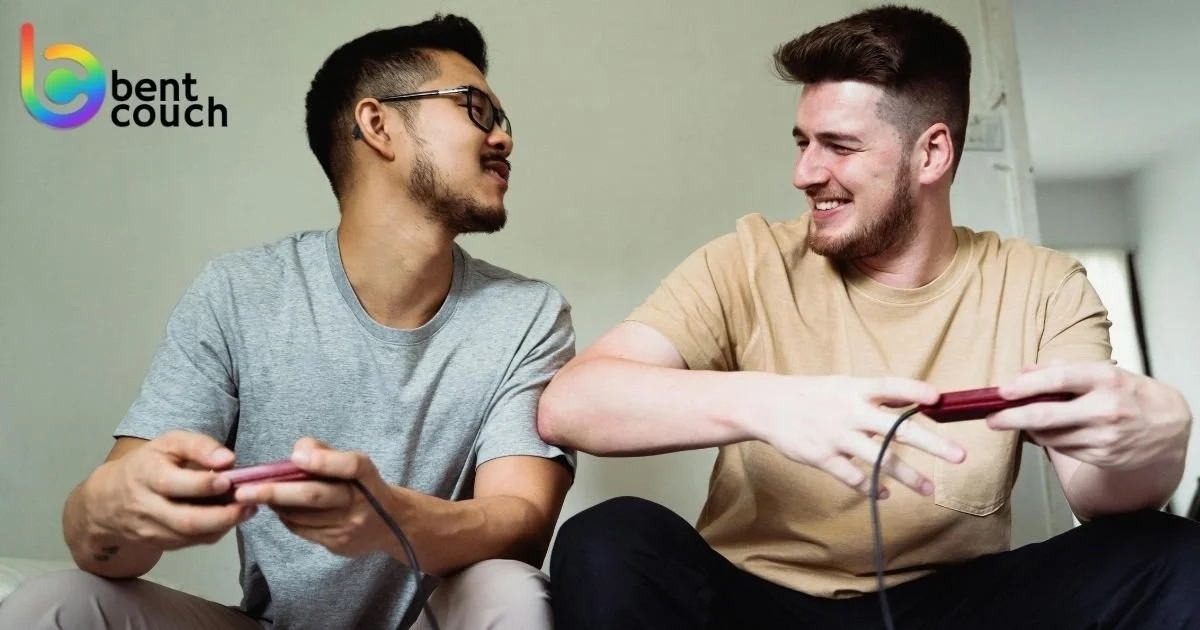
I’ve been thinking about gaming lately.
Many of my clients are gamers, and it has made me curious about what they get from it. The enjoyment, obviously. But also the friendships, the routine, the chance to switch off, and perhaps somewhere they feel they belong.
I wonder how often we actually ask about those things.
It’s easy to look at someone spending hours in front of a screen and think they should get out more. Find a hobby. Meet some people.
But what if they already have?
What if the people they look forward to seeing are on the other side of that screen?
Who’s waiting for you when you log on?
Imagine finishing a day where you’ve felt overlooked, uncomfortable or just bloody exhausted.
You log on. There are people to talk to. Something to do together. Someone who’s pleased you’ve turned up.
That might be a meaningful part of your day.
We talk a lot about loneliness, particularly among gay and queer men. Yet we can be quick to dismiss connection when it happens somewhere we don’t understand.
A friendship doesn’t become meaningless because you haven’t sat across a table from each other.
In GLAAD’s 2024 US survey, 71% of LGBTQ gamers said they had friends they could game with. [1] That doesn’t describe everyone’s experience or tell us exactly what’s happening here in Australia. But it’s a useful reminder to ask who someone is connecting with before assuming they’re alone.
I’d want to know whether those friendships feel supportive. Whether you can be yourself. Whether you finish a session feeling like you’ve spent time with people who care about you.
If loneliness is something you’re experiencing, I’ve also written about recognising loneliness and finding connection.
Sometimes connection means getting together to play
There’s also something worth saying about men getting together in the same room to play.
A few mates on the couch with controllers. A board game around the table. A regular night that gives you something to look forward to.
Sometimes it’s easier to connect when you’re doing something together. You don’t have to arrive with a big story or know how to start a deep conversation. You can play, laugh, have something to eat and let the conversation happen along the way.
And perhaps, somewhere between turns, someone asks how your week has been. You find yourself saying a little more than you expected.
For gay and queer men looking for friendship, a welcoming games night can offer another way to meet people around a shared interest. Somewhere you can turn up without the expectation of dating or sex.
It doesn’t have to become a serious conversation to matter. Enjoyment, company and being included are worthwhile in themselves.
Sometimes belonging starts with something as simple as: "Are you coming next week?”
How much of yourself do you have to hide?
For some of us, being ourselves has taken a fair bit of work.
We’ve learnt to read the room. Think before mentioning a partner. Decide whether it’s safe to say we’re gay. Adjust how we speak or what we share.
It can be tiring.
So I can understand the appeal of a space where you have more choice about how you show up. Perhaps through a character. Perhaps through a group that shares your interests. Perhaps with people who accept you without needing you to explain your whole life first.
In that same survey, 66% of LGBTQ gamers said gaming allowed them to express themselves in ways they didn’t feel comfortable doing elsewhere. [1]
There’s something worth paying attention to there.
But there’s also a less comfortable part: 52% reported harassment while playing online. [1]
Being online doesn’t protect us from homophobia or transphobia. The community you’re in matters. So does how you’re treated within it.
If a space that’s meant to help you unwind leaves you feeling ashamed, targeted or on edge, that deserves a conversation too.
If you’re finding it difficult to feel comfortable being yourself, identity counselling can offer space to explore that.
Sometimes it feels good to know you’re getting somewhere
Life can be frustratingly vague about progress.
You put effort into work, relationships or your wellbeing, and some days you’re left wondering whether any of it is making a difference.
In a game, there might be a clear challenge. Something to learn. A level to complete. Progress you can actually see.
I wonder whether that’s part of the appeal for some people. Having somewhere you feel capable, especially when other parts of life feel uncertain.
I wouldn’t assume that’s why a particular person plays. I’d ask them.
And sometimes the answer will simply be: "Because I enjoy it.”
Fair enough. We don’t need to turn every enjoyable thing into an issue to work on.
When does switching off start costing you?
We all need a break from life sometimes.
The question I’d be interested in is how you feel when you come back to it.
Have you had some fun, caught up with friends and given yourself a breather? Or is it three in the morning, you’ve got work tomorrow, and you’re frustrated because you meant to stop hours ago?
Perhaps your partner feels they’re getting very little time with you. Perhaps you’re putting off something difficult, and it keeps getting bigger while you’re away from it.
Those things matter. They’re worth talking about without adding shame to the conversation.
Research also suggests that hours alone don’t provide a complete picture. A 2025 Oxford study found little association between playtime and wellbeing among mainly casual adult Nintendo players. [2] It doesn’t settle questions about intensive or problematic gaming, but it gives us reason to look at the wider picture.
Do you feel you have a choice about playing? Can you stop when you want to? What’s happening with your sleep, your relationships, your work and your spending?
And is gaming one of several things that helps you cope, or has it become the only thing you can turn to?
You can bring this into counselling
You don’t need to arrive in counselling ready to give up gaming.
You can tell me what you love about it. The friendships. The stories. The challenge. The things other people don’t seem to understand.
You can also tell me if it’s getting difficult to manage.
I’d want us to understand what gaming gives you, what you want to keep, and whether anything needs to change.
If it’s where you find connection, that connection matters. We can also explore what would help you feel more connected in other parts of your life, if that’s something you want.
My clients being gamers doesn’t tell me that gaming caused their difficulties. It tells me there’s a part of their world worth getting curious about.
And perhaps a useful place to start is this:
What do you find when you log on that you’d like more of when you log off?
If this has brought up something for you around connection, identity, anxiety or how you’re coping, you’re welcome to talk with me. Bent Couch Counselling offers LGBTQIA+ affirming counselling online across Australia and in person in Melbourne.
Book a free 15 minute Discovery Call, and we can talk about what you need.
Shaun
Sources
GLAAD. (2024). State of LGBTQ inclusion in video games. US survey findings developed with Nielsen Games. Read the report.
Oxford Internet Institute. (2025, March 12). It’s quality not quantity that predicts gamers’ wellbeing, new study finds. Summary of research published in Royal Society Open Science. Read the research summary.

