
Why I’m Asking Gay and Queer Men About Mental Health in 2026
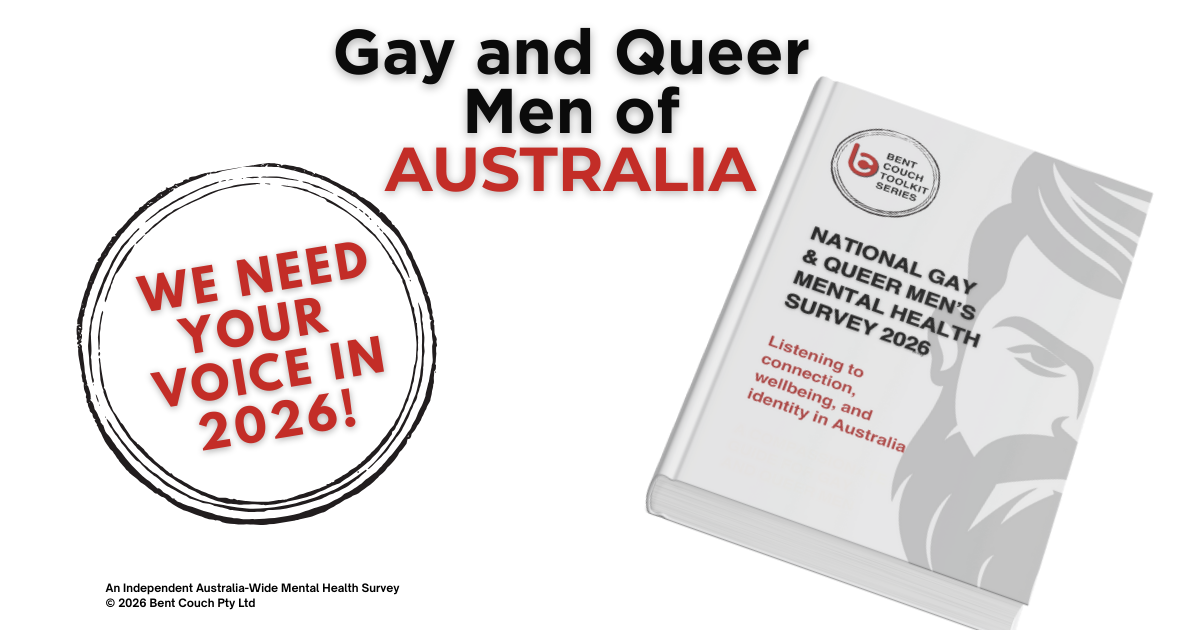
Mental health conversations are everywhere right now. And yet, in my work as a counsellor, when I sit with gay and queer men in counselling sessions, in groups, and in quieter one-on-one conversations, many still describe feeling unseen within them.
Not unseen in a dramatic sense. More subtle than that. In the moments where nuance gets lost, where lived experience becomes simplified, and where complexity is brushed over. In the space between “I’m fine” and “I’m really not”.
That space is where this mental health survey for gay and queer men sits.
Why focus specifically on gay and queer men?
In my work, I see how gay and queer men often carry a particular mix of pressure, adaptation, resilience, and unspoken expectation. Many of us grow up learning how to read a room, adjust ourselves, and decide how much of who we are feels safe to show.
That way of moving through the world does not simply disappear because we come out, build relationships, or appear to be doing well.
While the broader LGBTQIA+ community share many overlapping challenges, gay and queer men also experience distinct relational, cultural, and emotional patterns. These patterns are not always captured well in general mental health research or broad population surveys.
By asking questions specifically of gay and queer men, I am not excluding others. I am trying to listen more carefully. Meaningful understanding often requires focus, not generalisation.
Why now?
2026 feels like an important moment to pause and listen.
Over the past few years, so much has changed in how people connect, work, date, socialise, and cope. I hear men describe themselves as busy but disconnected. Fine but tired. Okay on the surface while holding more underneath.
In my work with gay and queer men across Australia, these themes come up again and again, even when lives look very different on the outside.
These experiences do not always reach crisis points. They do not always show up as emergencies. But they still shape wellbeing, relationships, and how men seek or avoid support.
This survey is not responding to a single event. It is responding to a quieter, longer-term question I keep returning to.
How are gay and queer men actually doing in everyday life?
What this survey is, and what it is not
This survey is not a diagnostic tool. It does not assess mental illness, make clinical judgements, or place people into categories.
Instead, it explores everyday experiences such as:
Sense of connection and belonging
Emotional strain and distress
Loneliness and support
Help-seeking and barriers to care
How men are managing, not just whether they are coping
All responses are anonymous and self-reported. The aim is not clinical precision. It is honesty. Human honesty.
Why lived experience matters
Many gay and queer men are very good at presenting as fine. Years of social learning often teach us how to minimise discomfort, avoid burdening others, and keep moving forward without stopping to reflect.
This survey invites something different.
It invites men to notice what is present for them right now, without needing to justify it, explain it, or correct it. Even brief reflection can be meaningful, both personally and collectively.
When enough voices are gathered together, patterns begin to form. Those patterns help inform better conversations, more responsive services, and a more accurate understanding of what support actually looks like in real life.
Why your voice matters, even if you feel okay
It can be tempting to think that surveys are only for people who are struggling.
They are not.
Men who feel mostly okay provide essential context. They help show what stability looks like. What supports are working. Where connection feels sufficient, and where it still falls short. Without those voices, the picture becomes incomplete.
If you are unsure how to describe your experience, that uncertainty itself is part of the story.
What happens with the results?
Over time, responses will contribute to an annual snapshot of gay and queer men’s mental health in Australia. The findings will be shared thoughtfully and carefully, with respect for the people behind the data.
This work is intended to inform:
Community conversations
Counselling and support services
Education and advocacy
Ongoing research and reflection
It is not about headlines. It is about holding patterns with care and learning from them.
A quiet invitation
If you are a gay or queer man living in Australia, I warmly invite you to take part.
The survey is short. It is anonymous. You can skip questions or stop at any time. There is no right way to answer.
And if this resonates, you may wish to share it with one other man you trust. Sometimes that is how listening begins.
Take the National Gay and Queer Men’s Mental Health Survey here
Shaun
Frequently Asked Questions
What is the National Gay and Queer Men’s Mental Health Survey?
It is an anonymous survey exploring connection, wellbeing, and everyday mental health experiences among gay and queer men living in Australia.
Who can take part in the survey?
The survey is open to gay and queer men who live in Australia. Participation is voluntary, and you can skip any question or stop at any time.
Is the survey anonymous?
Yes. The survey does not collect identifying information, and responses are analysed only in aggregate.
Is this a mental health diagnosis or assessment?
No. This survey is not a diagnostic tool. It does not assess mental illness or replace professional support. It focuses on lived experience rather than clinical outcomes.
Why is this survey focused only on gay and queer men?
Gay and queer men experience distinct social, relational, and emotional patterns that are not always well captured in broader mental health research. This survey aims to listen more closely to those specific experiences.
What will the survey results be used for?
Responses will contribute to an annual snapshot of gay and queer men’s mental health in Australia, helping inform community conversations, counselling services, education, and future research.

